Jaw Joint Treatment

Custom
MCB Splint

We find the position that suits your jaw
and make the appliance to match its condition that day.

In the examination, we look at how the jaw moves and how the teeth touch.
We check the front–back, side-to-side and vertical position of the lower jaw, and make a new appliance in the clinic at each visit.

MCB-L · For sleep
MCB-H · For in-clinic treatment

A first step in understanding treatment

Read the treatment principles first

Looking at how the jaw joint connects to the skull helps you understand why jaw position is given such weight in MCB splint treatment.

Why the Jaw Joint Matters

Who it is for

Are you concerned about symptoms like these?

Changes in facial appearance

  • Facial asymmetry
  • Receding chin
  • Prominent lower jaw
  • Gummy smile

Changes in body appearance

  • Scoliosis
  • Postural imbalance
  • Body shape imbalance

Body sensation

  • Tinnitus and other ear problems
  • Eye-related problems
  • Numbness

Body Pain

  • Jaw pain
  • Headache
  • Neck and shoulders
  • Lower back
  • Knees

Autonomic nerves and organ function

  • Rhinitis
  • Digestion
  • Urinary and reproductive
  • Neuropsychiatric
  • Endocrine

Motor function

  • TMJ Disorders
  • Tics
  • Dystonia
  • Tremor and stiffness
  • Imbalance of strength and movement

Treatment Principles 03 · Connections to Other Symptoms →

Comparing the appliances

H in the clinic, L while you sleep

Both appliances are made from single-use dental impression material to match the jaw position checked that day.

HIGH
Taller, with the mouth wide open

MCB-H · High

For treatment during visits

It is made in a taller position, with the jaw opened a little more. You wear it in the clinic, and the state of the jaw is then checked again. If the jaw position has changed, a new H is made in the newly checked position.

Early in treatment
One H session takes about 15 minutes (5 minutes to make + 10 minutes of wear)
Recommended at early visits
At least 5 H sessions · about 1 hour 30 minutes

LOW
Lower, with the mouth slightly open

MCB-L · Low

For sleep

It is made in a lower position, with the jaw opened only a little. It is used to maintain, during sleep, the jaw position set in the clinic and to reduce the stress placed on the teeth by grinding and clenching.

When it is made
One at each visit, before you go home
When it is used
While sleeping, until your next visit
An example of a single visit
Each appliance made counts as 1 treatment session 5 sessions are expected to take about 1 hour 30 minutes

If 5 H appliances for the clinic and 1 L appliance for sleep are made, that is 6 sessions in total for the day.

H wearing time

Why is the H splint worn for only 10 minutes?

In most patients, early in treatment, the craniosacral rhythm has been observed to tend to be maintained for about 10 minutes after the MCB-H splint is worn.

Contracting and expanding like a breath

Craniosacral rhythm

H splint

How long the rhythm is maintained after wear

Early in treatment
About 10 minutes

At first, the rhythm tends to be
maintained for about 10 minutes

After 120–140 sessions of H treatment
About 1 hourAbout 6 times the initial 10 minutes
After about 350 sessions of H treatment
About 1 hour 30 minutesThe time it is maintained tends to lengthen further
Our care is based on clinical observations gathered over the course of treating many patients.

How visit time changes around 130 MCB-H sessions

Based on one H session, including making and wearing the appliance.

Varies by person: 120–140 sessions

Early in treatmentAbout 15 minutes
From around 130 sessionsAbout 1 hour 10 minutes

The same 5 H sessions: how long will you be at the clinic?

As the wearing time for each H gets longer, the same 5 sessions take longer in a single visit.

Early · before about 130 sessions

About 15 minutes per H session

Having 5 H sessions in one day takes about 1 hour 30 minutes

After wearing time has lengthened · from around 130 sessions

About 1 hour per H session

Having 5 H sessions in one day takes about 5 hours

This is an example schedule for having 5 H sessions in one visit. Visit time varies with each patient’s wearing time and how the day’s treatment is carried out.

Treatment process

After an examination, we proceed according to your treatment goal

Jaw joint treatment only

  1. Examination and diagnosis
  2. MCB treatment
  3. Fine Bite Adjustment
  4. Making the MCB T/L Thermo splintFor maintenance

Jaw joint treatment followed by Invisalign

  1. Examination and diagnosis
  2. MCB treatmentAt least 250 sessions
  3. Invisalign
  4. Fine Bite Adjustment
  5. Making the MCB T/L Thermo splintFor maintenance

When MCB splint treatment is difficult at present

  1. Examination and diagnosis
  2. 20–30 sessions of MCB treatmentOptional · recommended
  3. Fine Bite Adjustment
  4. Making the MCB T/L Thermo splintTo prevent worsening

The figure of 250 sessions is our clinic’s guideline for proceeding to Invisalign after jaw joint treatment. Elementary school children may, depending on the diagnosis, begin orthodontic treatment after 150 sessions.

Checks and reassessment during treatment

What we check
during MCB splint treatment

01

Three-dimensional position of the mandible

We look at the front–back, side-to-side and vertical position of the mandible and its opening and closing movement.

02

Bite contacts

We check how the teeth meet before and after the appliance is used.

03

Chewing muscle function

We assess the function of the masseter and temporalis and changes in discomfort.

04

Fit of the appliance

We check how the appliance sits and whether it causes pressure or discomfort in the mouth.

How the MCB splint relates to fine bite adjustment

Even while a splint is in use, unstable tooth contacts or localized irritation of the oral mucosa may remain.

For that reason, we do not decide the direction of treatment on the result of the appliance alone; we also check the contacts of the natural teeth and irritation inside the mouth.

If dental treatment is needed, whether to proceed is decided after a separate diagnosis and explanation.

Reassessment after treatment

We check changes in jaw movement, bite contacts and discomfort both with the splint in and with it out.

The length of appliance use, the number of adjustments and the treatment plan may differ from patient to patient.

The aim of the MCB splint is not to move every patient’s mandible in a particular direction, but to assess each patient’s functional condition and draw up an appropriate treatment plan.

Note: The effects of splint treatment vary between individuals, and it does not guarantee permanent bite changes or improvement in symptoms elsewhere in the body.

Fees

MCB splint treatment fees

Fees shown are as of 2026. Your exact cost will be explained after an examination.

Examination and physical therapy
ItemFee
Temporomandibular disorder (TMD) assessment Required at the first visitAbout ₩40,000
Physical therapy At each follow-up visitAbout ₩11,000–17,000
MCB splint H and L · Not covered by insurance
SessionsFee
1 session₩70,000
10 sessions (₩40,000 per session)₩400,000
30 sessions + 2 complimentary · 32 in total (₩37,500 per session)₩1,200,000
50 sessions + 5 complimentary · 55 in total (about ₩36,364 per session)₩2,000,000
100 sessions + 12 complimentary · 112 in total (about ₩35,714 per session)₩4,000,000
130 sessions + 15 complimentary · 145 in total (about ₩34,414 per session)₩4,990,000

Refunds on MCB splint packages are available only within one month of the payment date. Sessions already used are charged at ₩70,000 per session and deducted from the amount paid, and the balance is refunded.

Treatment plan

Guide to number of sessions

The number of sessions depends on your goal.

If your goal is to reduce pain and discomfort

If the pain has eased and discomfort in everyday activities such as eating and speaking has gone away, treatment can be paused or ended after your condition has been checked at a visit. The number of sessions needed depends on your symptoms and progress.

If your goal is to stay comfortable over the long term

For sufficient improvement, we suggest a course of intensive treatment of around 130–500 sessions, after which an MCB Thermo splint (made of a semi-permanent material) is made for you to wear for maintenance. After that, we recommend a visit about once every 1–2 months to receive MCB-H and L appliances for ongoing care.

Even after one course of intensive treatment, consistent care matters if you want to stay comfortable.
Think of it as looking after your body as part of everyday life, as you would with exercise, massage or skin care.

  • Why changing habits matters Misalignment of the jaw joint ultimately arises from poor everyday posture or particular habits. If you have treatment without changing the underlying habits, your jaw can slowly return to its original misaligned state over time.
  • Ongoing care and the body’s own resilience The ideal course is to combine treatment with exercise and changes to everyday habits. If you build up your body’s own ability to keep its balance in this way, you can stay in good condition for a long time even without visiting the clinic often later on.

Everyday care

Care that works well alongside treatment

Gently massaging around the jaw with the fingertips

Relaxing tense muscles

  • Loosen the jaw, neck and shoulders with gentle stretching
  • Relax the muscles with massage or a warm compress
  • Watch for a habit of clenching your teeth
Pulling an exercise band with both hands

Add the strength training you need

  • During treatment, notice whether movement becomes easier than before, or whether the imbalance you felt during exercise lessens.
  • If movement has become easier, build up the strength to support your body with the muscle exercises you need.

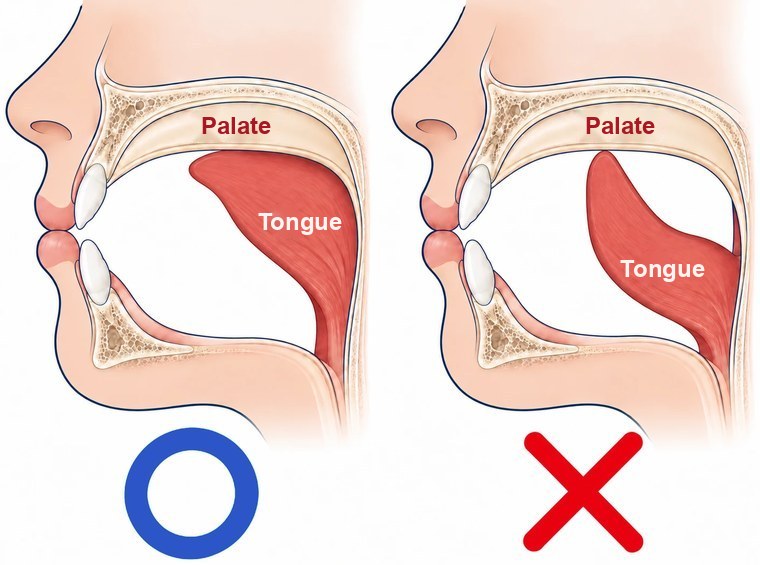
Keep your tongue resting against the roof of your mouth

Diagram showing, side by side, the broad surface of the tongue touching the roof of the mouth and only the tip touching
Tongue
Rest the whole tongue — front, middle and back — lightly against the roof of your mouth

Keep the tip of your tongue from touching the teeth and the incisive papilla (the small bump just behind the upper front teeth).

Teeth
Keep your upper and lower teeth slightly apart

When your mouth is at rest, try not to clench your teeth.

Lips
Relaxed and lightly closed

Talk to us about the treatment that suits you

GSB Orthodontics · 3rd floor, Ujangsan Hillstate Shopping Center, 657 Naebalsan-dong, Gangseo-gu, Seoul

Book a Consultation Call Us +82-2-3661-2211