Where you habitually bite down now
Where the teeth make the most contact
That off-center position becomes the reference, unchanged
Even when the teeth are set straight, the jaw that serves as the reference remains tilted.
Treatments · Invisalign
We assess not only tooth alignment but also the skeletal relationship of the jaws, bite contacts and the condition of the jaw joint. If the functional position changes, the reassessment is reflected in the orthodontic plan.
Invisalign® is a registered trademark of Align Technology, Inc.
A first step in understanding treatment
Reading first about how the jaw joint and teeth are connected helps you understand why the condition of the jaw joint is considered in the orthodontic plan.
We check the dental arches, jaw structure, bite and jaw joint together.
DetailsEven with the same clear aligners, the plan differs depending on the position in which the impression is taken.
DetailsWe look at the paths leading from jaw joint treatment to orthodontics and on to maintenance.
DetailsSame aligner. Different starting position.
An orthodontic plan starts from the position in which the impression of the mouth is taken.
If the center of the jaw and the dental midline do not match, it may have begun with misalignment of the skull,
so we look at the two together.
Press the buttons to compare.
If the jaw is off to one side, the lower dental midline is off with it. The center of the face, the center of the jaw and the dental midlines appear out of line with each other.
This is a diagram to aid understanding and is not to actual size or scale. Your actual jaw position and midlines are checked after an examination.
The house-on-sand analogy
If jaw position is the ground, the teeth are the house built on it.
Where you habitually bite down now
Where the teeth make the most contact
That off-center position becomes the reference, unchanged
Even when the teeth are set straight, the jaw that serves as the reference remains tilted.
The jaw position found to be comfortable for the skull
The position where the bones move in balance: the sphenoid for the lower jaw’s side-to-side position, the temporal bones for front to back and the occipital bone for height Dr. Lee’s clinical reference
We plan to set the jaw in position first, then bring the molars that are not touching into even support
The jaw position is stabilized first, and the teeth are aligned on top of it.
This explains how the starting point of the plan differs. Treatment results vary from person to person.

“Orthodontics is not only about moving teeth. It is about looking at function and balance too.”
Treatment process
The figure of 250 sessions is our clinic’s guideline for proceeding to Invisalign after jaw joint treatment. Elementary school children may, depending on the diagnosis, begin orthodontic treatment after 150 sessions.

Orthodontics and jaw joint function
Orthodontic treatment is dental treatment that improves tooth alignment and the bite relationship.
When planning orthodontic treatment, GSB Orthodontics checks the position of the teeth, the skeletal relationship of the jaws, bite contacts and the condition of the jaw joint together.
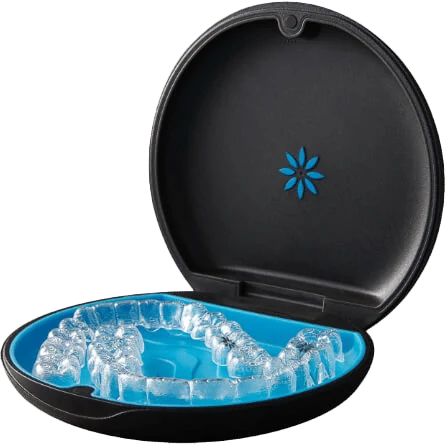
Clear aligners are used to adjust the position of the teeth in stages.
Whether it is suitable and how long treatment takes depend on the type of malocclusion, the difficulty of the tooth movement, oral health and other factors.
Facial asymmetry can involve a combination of skeletal, dental, soft-tissue and functional factors.
When assessing, a functional shift of the jaw joint needs to be distinguished from true skeletal asymmetry.
Depending on the degree of skeletal asymmetry, there are limits to how much can be improved by orthodontic treatment alone.
In some patients whose upper jaw is too narrow, a miniscrew-assisted maxillary expansion appliance may be considered.
The treatment plan is decided with skeletal maturity, the structure of the palate and periodontal condition taken into account.
Even when the lower jaw appears to sit back, it is important to distinguish skeletal factors from a functional change in position.
Where needed, we observe lower jaw movement and the repeatability of the bite, and reassess the goals and scope of orthodontic treatment.
Depending on the patient’s diagnosis, jaw joint treatment and orthodontic treatment can be carried out independently or in coordination.
Fees not covered by insurance
Orthodontic treatment takes 1–3 years, depending on how consistently the aligners are worn and how quickly the teeth move.
When the jaw position changes, the place where the teeth meet changes too. At our clinic, we first stabilize the jaw position with the MCB splint, then plan Invisalign treatment around that position.
We provide Invisalign treatment only for patients who have had at least 250 sessions of MCB splint treatment. As an exception, elementary school children may start after at least 150 sessions.
| Item | Fee |
|---|---|
| Orthodontic diagnosis | |
| Omnivac (temporary retainer)For retreatment cases with an existing fixed retainer | |
| Invisalign treatment Visits every 3 months requiredSingle payment · interest-free card installments available · fixed retainer included | |
| Monthly care feeCharged every month even if you visit once every 2–3 months. | |
| Miniscrew (temporary anchorage device)If used | |
| Removable retainerUsed after orthodontic treatment ends. The fixed retainer is included in the treatment fee. |
| Item | Unit | Fee | Valid for |
|---|---|---|---|
| MCB splint course ① | 145 sessions in total | 3 months | |
| MCB splint course ② | 112 sessions in total | 1 yearWe recommend using it within 3–6 months | |
| Temporomandibular disorder (TMD) assessment | Once, at the first visit | About | - |
| Physical therapy | Per follow-up visit | About | - |
· Course ① must be used within its 3-month validity period. Sessions not used within that period expire.
· Course ② is valid for 1 year. We recommend using it within 3–6 months.
· Examination and physical therapy fees are separate from the course fee and may vary depending on whether national health insurance applies.
The fees above are for services not covered by Korean national health insurance and are listed as of October 2026. The total cost may vary with the condition of your teeth and the length of treatment, and after diagnosis we tell you your individual cost before treatment begins. The length and results of orthodontic treatment vary from person to person, and side effects such as tooth sensitivity, gum discomfort and root resorption can occur.
You may also want to read
At your first visit, we start with a temporomandibular disorder (TMD) assessment to look at jaw position and the bite. Whether orthodontics is needed is decided together after that.